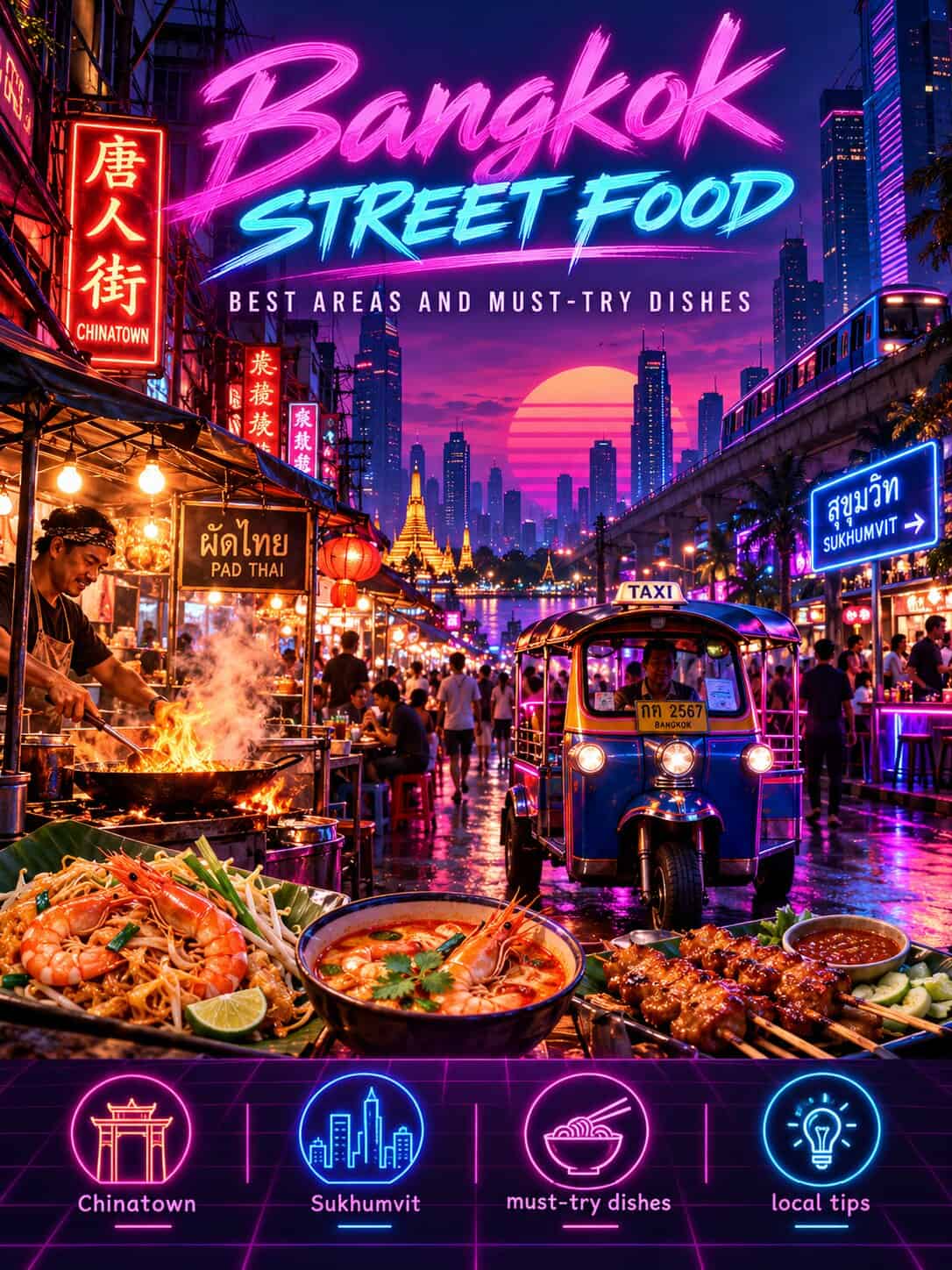
Bangkok street food is not a budget fallback. It is arguably the best food in the city, and a huge part of why the Bangkok food scene has the reputation it does. This Bangkok street food guide goes deeper than the classic-dishes overview. Whether you want a Bangkok street food tour on foot or simply wonder where to eat street food in Bangkok tonight, it explains how street eating works, which neighborhoods reward wandering and what to order. For the classics, see our Bangkok food guide.
Bangkok Street Food Areas at a Glance
| Area | Best for | Best time | Getting there |
|---|---|---|---|
| Yaowarat (Chinatown) | Evening street food: noodles, grilled dishes and sweets | After sunset, from early evening to late | MRT Blue Line to Wat Mangkon |
| Talat Noi | Old shophouse eateries, small noodle shops and coffee stands | Daytime and early evening | Walk from Yaowarat or take a river boat to Ratchawong Pier |
| Ari | Local street stalls plus good coffee shops | Daytime, a relaxed half-day | BTS Ari |
| On Nut | Residential street food scene with few tourists | Evening and weekends | BTS On Nut |
| Silom and Soi Convent | Weekday office-worker lunch market | Weekday lunch, around midday | BTS Sala Daeng or MRT Si Lom |
| Rot Fai (Train) Night Market, Ratchada | Evening food, retro bars and vintage goods | Evening, from about 5pm | MRT Thailand Cultural Centre |
Hours and stall lineups change, so check ahead for the evening markets, especially for Mondays, when some stalls close.
How Bangkok Street Food Actually Works
Most street stalls specialize in one dish, sometimes two, cooked the same way for years or decades. That specialization is a genuine sign of quality, not a limitation. Menus, where they exist, are often handwritten and Thai-only, and pointing at what the person next to you is eating is a completely normal way to order. Seating, if any, is usually plastic stools at a low table beside the cart. Payment is almost always cash, and it is common to eat standing or take food away in a small plastic bag.
Bangkok Street Food Prices
Bangkok street food prices are low: a street meal costs anywhere from 40 to 100 THB in most cases, and more for seafood or specialty items. A single noodle bowl or rice plate sits at the lower end of that range, while grilled seafood and multi-dish evenings cost more. Bring small bills, since most carts cannot break large notes.
Must-Try Street Dishes
Beyond the essentials covered in our food guide, several dishes are a street-cart phenomenon rather than something you would typically order at a sit-down restaurant. Khao man gai, Hainanese-style poached chicken over rice cooked in chicken fat and stock, comes with a ginger-garlic-chili dipping sauce and is a lunchtime staple. Kuay chap is a peppery rolled rice-noodle soup with pork offal, found mostly at 24-hour stalls. Look chin ping (grilled meatballs on a stick) and moo ping (grilled pork skewers) are classic walking snacks.
For sweets, look for roti sai mai, a thin crepe wrapped around spun sugar floss, and khanom buang, crispy coconut-cream-filled mini pancakes cooked to order. Grilled squid on a stick, pressed flat and charred over coals, is one of the most photogenic and genuinely good seafood snacks in the city.
Drinks to Try Street-Side
Thai iced tea (cha yen), a strongly brewed orange-red tea sweetened with condensed milk, is sold from nearly every food cart. Fresh coconut water straight from the shell is one of the most refreshing options in the heat. Sugarcane juice, pressed to order, is another classic. Roadside stalls also sell herbal drinks such as chrysanthemum tea, butterfly pea flower tea and the tart, cooling bael fruit drink nam matoom.
Best Street Food Areas in Bangkok
Yaowarat Street Food
Yaowarat, in Chinatown, is the classic place to start. Yaowarat street food is at its best after sunset, when the road fills with stalls, grills and queues, so bring an empty stomach. The easiest way in is the MRT Blue Line to Wat Mangkon, because traffic around the area is heavy. Share dishes so you can try more stalls, and expect crowds on weekends.
Talat Noi
Talat Noi, a historic riverside neighborhood between Chinatown and the Chao Phraya River, mixes old shophouse eateries that have operated for generations with a newer wave of small cafes and street art. It rewards wandering more than following a list: narrow lanes open onto small noodle shops and coffee stands with little warning. It is also far less crowded than Yaowarat a few blocks away.
Talad Rot Fai (Train Night Market), Ratchada
Distinct from the daytime Chatuchak Weekend Market, the Rot Fai (Train) night market in the Ratchada area has reopened on its original site and combines vintage goods and retro-themed bars with a large food section. It is one of the best-known Bangkok night food markets, with a livelier atmosphere than a typical day market, and it pairs naturally with a night out. For Bangkok night street food with fewer crowds, Yaowarat street food stalls and the side lanes of Chinatown are the alternative. Check the days before you go, since sources differ on weekday opening, and see our nightlife guide for what to do afterward. For the daytime alternative, see the weekend market guide.
On Nut and Ari
On Nut, at the far end of the Sukhumvit BTS line, and Ari, a few stops north of the city center, are mainly residential neighborhoods with strong local street food scenes and relatively few tourists. Ari also has good coffee shops alongside its street stalls, which makes it a reasonable half-day base if you want a slower, more local pace.
Soi Convent and the Silom Lunch Rush
Soi Convent, just off Silom Road in the business district, turns into a dense lunchtime street food market on weekdays, packed with office workers. Most stalls disappear by early afternoon. It is a better window into how Bangkok actually eats day to day, but it is only active on weekday lunch hours, so time your visit accordingly.
A Street Food Walk in Yaowarat and Talat Noi
- Start at MRT Wat Mangkon in the early evening and walk toward Yaowarat Road.
- Graze along Yaowarat: pick two or three stalls with local queues and order one dish each to share.
- Cut into the side lanes for small noodle shops and dessert stalls away from the main road.
- Walk on to Talat Noi for a coffee or a late snack in the quieter riverside lanes.
- Finish by the river and take a boat or a taxi back to your hotel.
This self-guided Bangkok street food tour takes two to three hours at a relaxed pace, and carry small cash. If you are still choosing where to base yourself, see our Bangkok hotel picks.
Best Times to Go for Street Food
Street food in Bangkok runs on different clocks depending on the area and the dish. Breakfast and lunch stalls, especially rice-and-curry and khao man gai carts, are often busiest and freshest from around 7:00 to 11:00am. Business-district lunch markets such as Soi Convent peak around midday on weekdays and largely vanish afterward. Evening markets such as Yaowarat and Rot Fai come alive after dark and run late, and a Bangkok night food market is the best place for night street food, while 24-hour dishes like kuay chap are a late-night or early-morning specialty.
How to Choose a Safe, Good Stall
A queue of local customers, especially office workers or families, is the most reliable signal of both safety and quality. Stalls that specialize in one or two dishes tend to outperform carts with a long menu. Watch the cooking where possible: food prepared fresh in front of you over visible heat is a simple safety check. A menu written only in Thai is often a good sign, since it usually means the stall is not aimed primarily at tourists.
What to Bring on a Street Food Walk
- Small cash, since most carts cannot break large notes and none take cards
- Wet wipes or hand sanitizer, since running water is not always nearby
- A reusable bag or container if you plan to buy several small items to eat later
- Tissues, which double as napkins; many stalls do not provide any
- An appetite for wandering rather than a fixed plan
Street Food Etiquette and Ordering Tips
- Pointing at a dish, either on display or on someone else’s table, is a completely normal way to order
- Specify spice level upfront: “mai phet” (not spicy) or “phet nit noi” (a little spicy) both work
- Tipping is not expected at street stalls, though rounding up is common
- Pack out any trash if a bin is not immediately visible
For a different region, see our Chiang Mai food guide.
Frequently Asked Questions
What is the best street food dish to try first in Bangkok?
Khao man gai is a good entry point: mild, widely available and representative of the simple single-dish cart that defines Bangkok street food.
How much does Bangkok street food cost?
A street meal typically costs 40 to 100 THB, and seafood or specialty items cost more. That is significantly less than a modest sit-down restaurant, usually with no drop in quality.
Where to eat street food in Bangkok for the first time?
Yaowarat in Chinatown is the classic evening choice, and it is easy to reach by MRT. For a calmer, more local experience, try Ari or On Nut.
Is Yaowarat street food open during the day?
Yaowarat comes alive in the evening, when street stalls set up along the road. Come after sunset for the full experience, and check ahead for Mondays, when some stalls close.
Do I need to speak Thai to order street food?
No. Pointing, gesturing and a few basic words for spice level and quantity are enough at the vast majority of stalls.
Is Talad Rot Fai the same as Chatuchak?
No. Chatuchak is a large daytime weekend shopping market, while the Rot Fai night market in Ratchada is an evening venue built around vintage goods, bars and food, with different hours.
What is the best area for street food away from tourist crowds?
Talat Noi, On Nut and Ari offer genuinely local street food scenes with far fewer tourists than Yaowarat.