Quick answer: November to February is the most reliable window across Thailand. The Andaman coast (Phuket, Krabi) is rainy with rough seas from about June to August, while the Gulf islands (Samui, Phangan, Tao) often have only lighter rain and good conditions in those months.
There is no single best time to visit Thailand. There is a best time for whichever part of the country you are going to, and the two coasts run on different rainy seasons. Get the timing right for your route and you will skip the worst of the rain and the crowds; get it wrong and you might land in Phuket during a washout while Koh Samui has fine weather a short flight away. This guide covers the best month to visit Thailand by region, the Thailand rainy season, and when to visit Thailand for the beach, the north or the festivals.
Thailand Weather by Month: Region at a Glance
Use this table as a starting point. Conditions vary from year to year, so treat it as a typical pattern rather than a forecast.
| Month | Bangkok and Central | Andaman Coast (Phuket, Krabi) | Gulf Islands (Samui, Phangan, Tao) | North (Chiang Mai) |
|---|---|---|---|---|
| January | Cool, dry, pleasant | Peak season, dry | Generally dry, good conditions | Cool, dry, one of the best months |
| February | Warming up, dry | Peak season, dry | Generally dry, good conditions | Cool, dry, burning season may begin late in the month |
| March | Hot, dry | Dry, getting hot | Dry, warming up | Hot, burning season |
| April | Very hot, Songkran | Hot, mostly dry | Hot, mostly dry | Very hot, burning season often at its worst |
| May | Hot, rain increasing | Monsoon starts, seas rougher | Mostly dry, some showers | Rain begins, air clears |
| June | Rainy season | Rainy, rough seas | Lighter rain, often good conditions | Rainy, lush and green |
| July | Rainy season | Rainy, rough seas | Lighter rain, often good conditions | Rainy season |
| August | Rainy season | Rainy, rough seas | Lighter rain, often good conditions | Rainy season |
| September | Among the wettest months | Rainy, some boat services reduced | Showers, still often good conditions | Rainy season |
| October | Rain easing | Rain easing late in the month | Rain increasing | Rain easing, cooler nights begin |
| November | Cool season begins | Dry season returns | Often the wettest month | Cool, Yi Peng and Loy Krathong |
| December | Cool, dry, peak season | Peak season, dry | Rain easing, improving | Cool, dry, peak season |
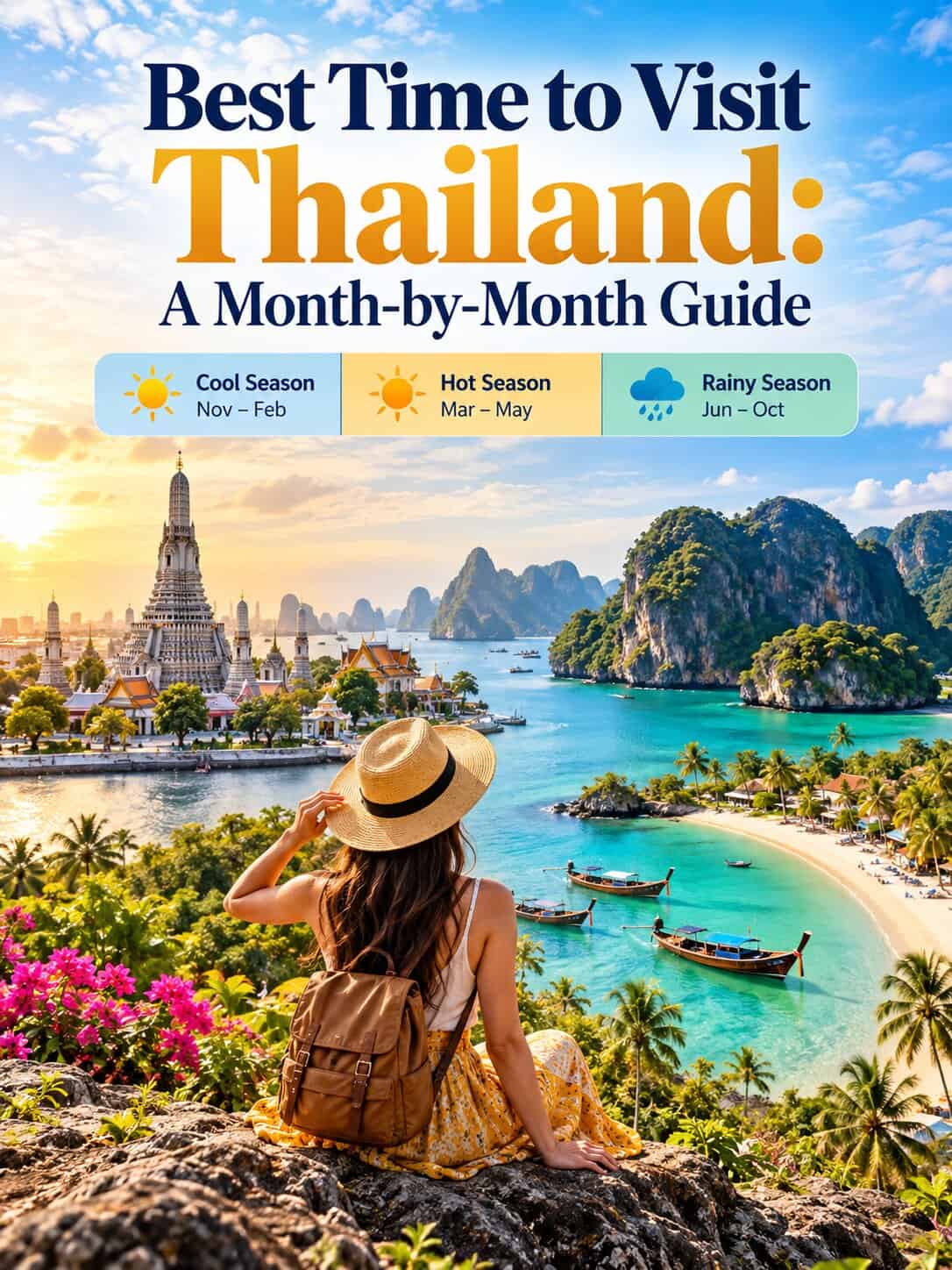
The Cool Season (Mid-October to February): The Best Time to Visit Thailand for Most Trips
This is the best time to visit Thailand for most travelers, and peak season in most regions for good reason. Bangkok and the central plains are at their most comfortable, the Andaman coast enjoys calm, clear seas and reliable sunshine from around November, and the north is genuinely cool, especially at night. It is also the most crowded and most expensive stretch of the year, particularly around Christmas and New Year, so book accommodation well ahead if you are traveling in December. November brings Chiang Mai’s Yi Peng lantern festival, one of the most photographed events in the country, but it is also the one Gulf-island exception: November is often Koh Samui’s wettest month, while the rest of the country is drying out.
The Hot Season (Mid-February to Mid-May): Best Time to Visit Thailand With Planning
For the Gulf and the Andaman coast this can still be a good time to visit Thailand, if you can handle the heat. March and April are Thailand’s hottest months, with Bangkok very hot and humid. The Andaman coast stays largely dry through this period and remains a reasonable choice if you can handle the heat, while the Gulf islands are also in a drier stretch. The north needs careful planning: burning season runs roughly from late February through April, when agricultural burning can blanket Chiang Mai and the surrounding valleys in smoke and push air quality into unhealthy levels. Check our Chiang Mai weather and burning season guide before booking a northern trip in this window. April also brings Songkran (13 to 15 April), Thai New Year celebrated with a nationwide water fight, which is fun if you are prepared to get soaked.
The Thailand Rainy Season (Mid-May to Mid-October): Not as Bad as It Sounds
This is where Thailand’s regional split matters most. On the Andaman coast it is genuinely the low season: the southwest monsoon brings rough seas and heavy rain, ferry services to smaller islands reduce or stop, and many beach operations close, especially from June to September. The Gulf islands (Koh Samui, Koh Phangan, Koh Tao) follow a different pattern, with generally lighter rain through the middle of the year and their heaviest rain later, around October to December. Bangkok’s rain during the Thailand rainy season is typically a heavy but brief afternoon downpour rather than an all-day washout, so it disrupts sightseeing less than the name suggests. The clear upside is fewer tourists and lower prices, which makes this a smart window for budget-conscious trips willing to work around an afternoon shower.
Best Time to Visit Thailand by Priority
The best time to visit Thailand depends on your goal. If your main goal is the Andaman beaches around Phuket, Krabi or Phi Phi, aim for November to April and avoid the peak monsoon months. If you are diving or relaxing on the Gulf islands, the middle of the year is often a good choice, and the conventional November to February advice does not apply there. If budget matters more than perfect weather, June to September offers the lowest prices nationwide, with only the Andaman coast genuinely compromised. And if your trip includes Chiang Mai, treat February to April as a season to avoid unless you can handle the smoke, with November to February the reliable window up north. Not sure which month to pick? For a first trip, the best time to visit Thailand overall is December or January. December and January are the safest overall, and October is a good value-for-weather shoulder month in many regions.
Combining Regions: The Best Time to Visit Thailand’s Two Coasts
Because the two coasts have different rainy seasons, a single trip can often dodge bad weather by choosing the right order. From November to April, start on the Andaman side (Phuket, Krabi) and finish in the north, while a rainy-season trip can focus on the Gulf islands and leave Phuket for another visit. Whatever the season, pack for it: our Thailand packing list shows what changes between the cool, hot and rainy seasons.
Festivals Worth Timing a Trip Around
A handful of annual events are worth building an itinerary around. Songkran (13 to 15 April) turns the country into a water fight for Thai New Year. Chiang Mai’s Yi Peng lantern festival and Loy Krathong, when Thais float candlelit offerings on rivers and canals, usually fall in November, following the lunar calendar, so check the exact dates before you book. On Koh Phangan the Full Moon Party runs monthly year-round, so it is more about checking the date against your trip than timing a whole holiday around it; see our Full Moon Party guide. For what is on in a specific month, see our events calendars for September and October.
Peak, Shoulder and Low Season: What Changes Beyond Weather
Weather is not the only variable. Peak season (roughly December to February, plus Songkran week in April) brings the best weather in most regions alongside the highest hotel prices and biggest crowds, so book accommodation a couple of months ahead, which matters most if you want the best time to visit Thailand for good weather. Shoulder season (March to May and October to November, varying by region) often gives a good balance of weather and price. Low season on the Andaman side (roughly June to September) is where the bargains show up. For destination-specific monsoon timing, our Phuket weather guide and Koh Phi Phi weather guide go deeper than a country-wide overview can.
Frequently Asked Questions
What is the best month to visit Thailand?
December and January are the safest bet nationwide, with cool, dry weather in most regions, though they are also the most crowded and expensive months to travel.
Is it true Thailand has two opposite rainy seasons?
Largely, yes. The Andaman coast (Phuket, Krabi) has its heaviest rain during the southwest monsoon from roughly May to October, while the Gulf islands (Koh Samui, Koh Phangan, Koh Tao) tend to be wettest later in the year, around October to December, so one side’s rainy season often lines up with the other’s dry season.
When is the Thailand rainy season?
Officially, Thailand’s rainy season runs from about mid-May to mid-October, followed by the cool season until about mid-February and the hot season until mid-May. The south and the Gulf coast follow their own timing, so check your specific destination.
When should I avoid visiting Chiang Mai?
Late February through April, during burning season, when agricultural fires create hazardous air quality across the north. November through February is the region’s best window instead.
Is the rainy season a bad time to visit Thailand overall?
Not necessarily. Rain in central Thailand is often a brief afternoon downpour, prices drop and crowds thin, and the Gulf islands are generally less affected during the middle of the year. The Andaman coast is the region genuinely compromised.
When is the best time to visit Thailand for beaches?
For the Andaman coast (Phuket, Krabi), roughly November to April. For the Gulf islands (Samui, Phangan, Tao), the drier months are generally from around January to September, with the heaviest rain late in the year.
Pingback: Floating Market Bangkok: Damnoen Saduak vs Amphawa