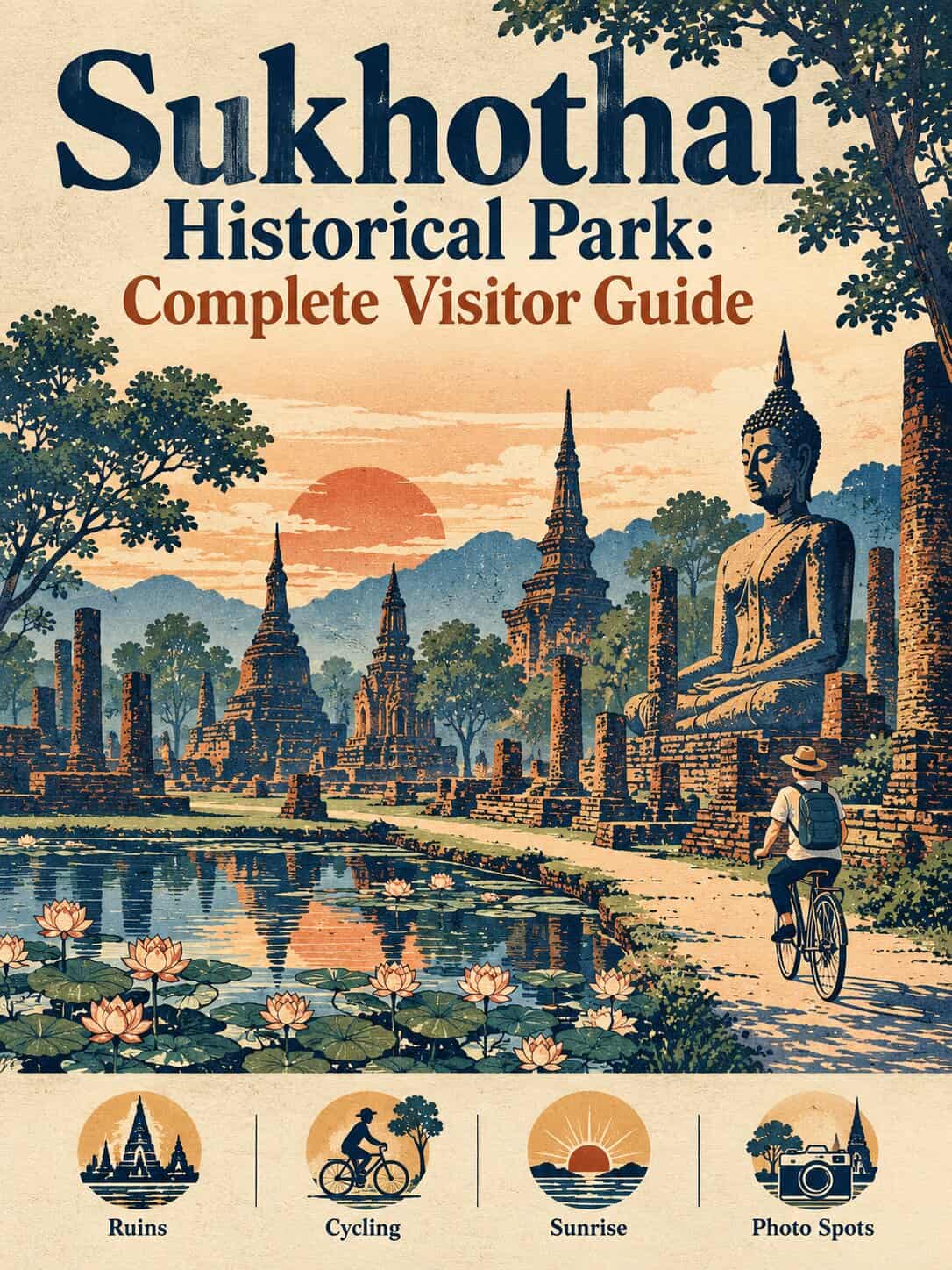
Sukhothai Historical Park preserves the remains of a major early Thai kingdom that flourished during the 13th and 14th centuries. Its temples and royal monuments form part of the UNESCO World Heritage property Historic Town of Sukhothai and Associated Historic Towns, inscribed in 1991 together with Si Satchanalai and Kamphaeng Phet. Visitors usually explore the Central Zone first, then cycle to Wat Si Chum in the Northern Zone.
Sukhothai Historical Park: Tickets and Essential Facts
| Zone | Entry Fee | Key Temples |
|---|---|---|
| Central Zone | 200 THB (+10 THB bicycle) | Wat Mahathat, Wat Si Sawai, Wat Sa Si |
| Northern Zone | 120 THB (+10 THB bicycle) | Wat Si Chum, Wat Phra Phai Luang |
| Western Zone | 120 THB (+10 THB bicycle) | Wat Saphan Hin |
| Southern & Eastern Zones | Free | Smaller, less-visited ruins |
| Ramkhamhaeng National Museum | 200 THB | Separate ticket, artifacts and history |
Simple cost example: Rent a bicycle for 50 THB and visit the Central and Northern Zones: 320 THB in entrance fees, roughly 20 THB for taking the bicycle into those zones, for a total of about 390 THB per person. Visiting all three paid zones with the same rental bicycle costs about 520 THB. Thai nationals pay less.
Sukhothai Historical Park: UNESCO Status
The park is part of the UNESCO property Historic Town of Sukhothai and Associated Historic Towns, inscribed in 1991. The World Heritage inscription also includes Si Satchanalai and Kamphaeng Phet, which are separate destinations and not additional sightseeing zones within this park.
Central Zone: The Main Event
The Central Zone contains the park’s best-known monuments. Wat Mahathat was the royal and religious centre of Sukhothai, with a distinctive lotus-bud-shaped principal chedi and numerous subsidiary stupas. Allow about 90 minutes to two hours to see it together with Wat Si Sawai and Wat Sa Si without rushing. Wat Si Sawai has three Khmer-style prangs reflecting the region’s earlier cultural connections. Wat Sa Si stands on an island reached by a bridge and is especially atmospheric in soft morning or late-afternoon light. Both sites are within the paid Central Zone.
Wat Si Chum: Northern Zone Buddha and Opening Hours
Wat Si Chum is famous for the approximately 15-metre-high seated Phra Achana Buddha, framed by the opening of a square mondop. The Northern Zone also contains Wat Phra Phai Luang, an earlier Khmer-influenced temple complex. Foreign adult entry to the Northern Zone is 120 THB, separate from the 200 THB Central Zone ticket, and its listed opening hours are 7:30 AM–5:30 PM.
Sukhothai Temples: Wat Saphan Hin in the Western Zone
Wat Saphan Hin stands on a hill reached by a steep stone path in the Western Zone. The standing Buddha and panoramic views reward visitors who are comfortable walking uphill on uneven surfaces. The Western Zone admission is 120 THB for foreign adults and the listed visiting window is 8 AM–4:30 PM, so visit earlier rather than leaving the climb until dusk.
Sukhothai Bike Rental and Getting Around the Park
Bicycle rental shops around the main entrance commonly advertise basic bikes from about 30–50 THB per day. A small separate fee (about 10 THB) has been charged for taking a bicycle into each paid zone. A bike is especially useful between the Central and Northern Zones. Sightseeing tram and golf-cart offers vary by operator and availability; the simplest independently visitable combination is a rented bicycle plus the central and northern tickets.
Sukhothai Bike Rental: Costs and Practical Advice
A basic rental bicycle near the Central Zone entrance typically costs around 30–50 THB per day. Check brakes, tyres and the lock before leaving. A small extra fee may apply each time you enter a paid zone with the bike. Central and Northern Zones make an easy half-day combination, while the Western Zone includes a steep final walk where cycling cannot replace climbing on foot.
How to Visit Sukhothai without Cycling
Walk the Central Zone, where the principal monuments cluster together, and arrange separate road transport for Wat Si Chum. Local tram services can reduce walking inside the central area, but do not assume they cover the Northern and Western Zones. Avoid relying on one fixed tram or golf-cart fare, as different services operate in the area.
Sukhothai Historical Park Opening Hours by Zone
The Central Zone is listed as open 6:30 AM–7:30 PM from Sunday through Friday and 6:30 AM–9 PM on Saturdays when selected ruins are illuminated. The Northern Zone, including Wat Si Chum, opens 7:30 AM–5:30 PM daily; the Western Zone opens 8 AM–4:30 PM. Do not assume the same closing time applies to every temple or that unstaffed Southern and Eastern ruins are suitable for visiting at night. Hours can change, so confirm locally.
Sukhothai Historical Park Opening Hours: All Three Ticketed Zones
| Zone | Opening hours | Planning tip |
|---|---|---|
| Central, Sun–Fri | 6:30 AM–7:30 PM | Start early for cooler walking conditions |
| Central, Saturday | 6:30 AM–9:00 PM | Selected monuments illuminated after dark |
| Northern, including Wat Si Chum | 7:30 AM–5:30 PM daily | Arrive well before the late-afternoon closure |
| Western | 8:00 AM–4:30 PM daily | Schedule the hill walk during daylight |
These are the published access hours. Staff may restrict specific monuments during maintenance, ceremonies or adverse weather.
Best Time to Visit Sukhothai Historical Park
The cooler months from November to February generally offer more comfortable cycling and temple visits. Sukhothai’s Loy Krathong and Candle Festival draws large crowds, with cultural performances and illuminated monuments; book accommodation early during the festival and see our Thailand events in November guide for dates. Visit paid temples soon after opening for cooler conditions, carry drinking water, and leave the exposed Western Zone hillside for a mild morning.
Where to Stay Near Sukhothai Historical Park
Old Sukhothai (Mueang Kao) places visitors near the Historical Park gates and bicycle rentals, making it convenient for an early start. New Sukhothai has more everyday services and intercity transport connections but requires a local transfer to the ruins. Select your base according to arrival time and whether you want to visit the park over one or two mornings. See our best hotels in Sukhothai guide for named picks.
Sukhothai Historical Park vs Ayutthaya
Sukhothai provides a landscaped archaeological setting with widely spaced monuments and especially rewarding bicycle routes. Ayutthaya is much easier to reach from Bangkok and contains monumental ruins among modern urban streets. Sukhothai is usually better as an overnight stop, while Ayutthaya works as a Bangkok day trip; see our Ayutthaya Historical Park guide if you are deciding between the two.
Sukhothai Historical Park: Eastern and Southern Temples
The Eastern and Southern areas contain scattered historic remains outside the three main ticketed zones. They are useful additions if you have extra daylight and independent transport, but are less suitable for a short first visit than Wat Mahathat and Wat Si Chum. Do not explore isolated archaeological areas at night simply because no ticket gate is operating.
How to Visit Sukhothai: One-Day Cycling Route
Start at the Central Zone when it opens, visiting Wat Mahathat, Wat Si Sawai and Wat Sa Si. After a break, cycle north to Wat Si Chum and Wat Phra Phai Luang before their 5:30 PM closing time. Add Wat Saphan Hin only if you can reach the Western Zone before its 4:30 PM closing time; for a comfortable single day, central plus north is the strongest combination.
Sukhothai Historical Park: Suggested Half-Day and Full-Day Itineraries
| Time | Destination | What to see |
|---|---|---|
| 6:30–8:00 AM | Central Zone | Wat Mahathat and early light |
| 8:00–9:30 AM | Central Zone | Wat Si Sawai and Wat Sa Si |
| 9:30–10:00 AM | Break / ride north | Water and shade |
| 10:00–11:30 AM | Northern Zone | Wat Si Chum and Wat Phra Phai Luang |
| After lunch, optional | Western Zone | Wat Saphan Hin; enter before 4:30 PM |
| Late afternoon | Central Zone | Return for photographs if your ticket permits re-entry |
For a half-day visit, finish after the Northern Zone. Check your admission ticket’s re-entry conditions before leaving a gated area. Bring at least one litre of drinking water per person in hot weather and avoid strenuous hill walks in midday heat.
How to Visit Sukhothai from Bangkok or Chiang Mai
Sukhothai has no station on Thailand’s north–south railway. Buses connect Sukhothai with Bangkok and northern cities, while flights serve Sukhothai Airport outside the town. The principal bus terminal is in New Sukhothai, approximately 12 kilometres from Old Sukhothai and the Historical Park. Allow time for a local songthaew, taxi or hotel transfer; Sukhothai Airport is farther away and needs a separate road transfer.
How to Visit Sukhothai: Travel Connections
| Origin | Transport | Typical planning time |
|---|---|---|
| Bangkok | Intercity bus | About 6–8 hours |
| Bangkok | Flight to Sukhothai Airport | About 1h20 flying, plus airport transfer |
| Chiang Mai | Intercity bus or road transfer | About 5–6 hours |
| Phitsanulok | Bus or road transfer | About 1–1.5 hours |
| New Sukhothai bus terminal | Local road transport to Old Sukhothai | Approximately 12 km |
There is no direct passenger train to the archaeological park. Phitsanulok is the most practical nearby rail gateway. For most visitors arriving from Bangkok or Chiang Mai, one night near Old Sukhothai gives enough time for an unhurried early-morning visit.
Frequently Asked Questions
How much does it cost to visit Sukhothai Historical Park?
Foreign adults pay 200 THB for the Central Zone and 120 THB each for the Northern and Western Zones, or 440 THB to visit all three, plus a small bicycle fee per zone if you take a bike inside. The Southern and Eastern areas have no ticket gate.
How many days do you need for Sukhothai Historical Park?
Allow four to six hours for the Central and Northern Zones by bicycle, with breaks. A full day is better if adding the Western Zone, which closes at 4:30 PM. Stay overnight nearby to visit early in cooler weather.
What is the most famous temple in Sukhothai Historical Park?
Wat Mahathat is the best-known central temple, while Wat Si Chum in the Northern Zone is famous for its enormous seated Phra Achana Buddha. Both are priorities for a first visit.
Is Sukhothai Historical Park worth visiting if you’ve already seen Ayutthaya?
Yes — the two sites feel genuinely different, with Sukhothai’s ruins more spread out, less crowded, and reflecting an earlier, distinctly Thai architectural style.
Deciding between the two ancient capitals? Our Ayutthaya vs Sukhothai comparison breaks down the trade-offs directly.
What are Sukhothai Historical Park opening hours?
The Central Zone opens 6:30 AM–7:30 PM Sunday to Friday and 6:30 AM–9 PM on Saturday. The Northern Zone opens 7:30 AM–5:30 PM and the Western Zone 8 AM–4:30 PM.
How much does Sukhothai bike rental cost?
Allow about 30–50 THB per day for a basic bicycle near the entrance, plus a small access fee for each ticketed zone entered with the bike.
Is Wat Si Chum included with the Central Zone ticket?
No. Wat Si Chum belongs to the separately ticketed Northern Zone, which costs 120 THB for foreign adults.
How tall is the Wat Si Chum Buddha?
Phra Achana is an approximately 15-metre seated Buddha framed within a tall mondop.
Can I visit Sukhothai Historical Park without a bicycle?
Yes. The Central Zone is walkable; use local road transport for the farther Northern and Western temples.
Is Sukhothai Historical Park open on Saturday nights?
The Central Zone is open until 9 PM on Saturdays, with illumination of selected monuments. Wat Si Chum does not share that late closing time.
What is the best time of year for Sukhothai temples?
November–February generally offers more comfortable temperatures. Loy Krathong is atmospheric but increases demand for rooms.
Can I visit Sukhothai from Bangkok in one day?
The road journey is usually about 6–8 hours one way, so a normal day trip is impractical. Plan an overnight stay.