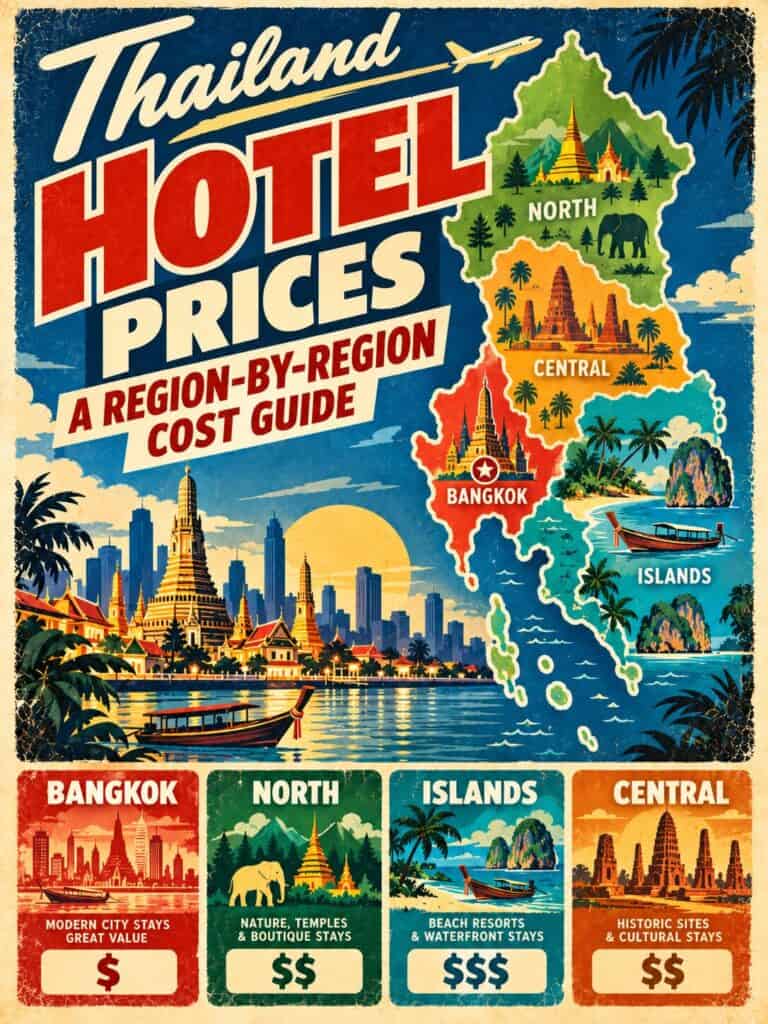
Quick answer: In high season (November to March), a standard double room costs roughly $10–50 on a budget and $50–120 mid-range in Bangkok, $50–100 mid-range in Phuket and $30–70 mid-range in Chiang Mai. Shoulder and low season usually bring prices down 20–40%.
Thailand hotel prices swing more by region than almost anywhere else in Southeast Asia — the same budget that gets a beachfront pool villa in Krabi barely covers a mid-range room in Bangkok during high season, and a dorm bed in Pai costs less than a coffee in a Bangkok hotel lobby. Rather than one national average, what actually matters is how each region’s price ladder is built. This guide breaks it down region by region, in USD per night for a standard double room in high season, so you can budget a multi-stop trip realistically instead of guessing.
How to Read These Thailand Hotel Prices
Every range in these Thailand hotel prices reflects roughly what you’d pay for a real, bookable room at that tier during high season (November through March in most of the country) — not the absolute cheapest listing on a booking site, and not a single outlier luxury villa. Shoulder and low season typically bring prices down 20-40% in the same hotels, sometimes more on the islands. A dash in the table means that tier is essentially absent in that region — not every destination has an ultra-luxury option, and that’s useful information in itself.
| Region | Budget | Mid-Range | Upper-Mid | Luxury | Ultra-Luxury |
|---|---|---|---|---|---|
| Bangkok | $10-50 | $50-120 | $120-250 | $250-450 | $450-1,000+ |
| Phuket | <$50 | $50-100 | $100-200 | $200-450 | $450-1,500+ |
| Chiang Mai | $10-30 | $30-70 | $60-150 | $150-350 | $350-500+ |
| Krabi / Railay | $15-45 | $45-140 | $140-230 | $230-400 | $400-1,500+ |
| Koh Samui | <$50 | $50-100 | $100-250 | $250-450 | $450-2,000+ |
| Koh Phangan | $10-35 | $35-80 | $80-150 | $150-350 | — |
| Koh Tao | $10-30 | $30-70 | $70-130 | $130-250 | — |
| Koh Phi Phi | $12-40 | $40-90 | $90-180 | $180-400 | $400-700+ |
| Pai | $8-25 | $25-55 | $55-100 | $100-200 | — |
| Chiang Rai | $10-30 | $30-65 | $65-120 | $120-250 | $250-500+ |
| Ayutthaya | $12-35 | $35-70 | $70-130 | $130-250 | — |
| Sukhothai | $10-25 | $25-50 | $50-90 | $90-180 | — |
Use this table to compare Thailand hotel prices at a glance, then jump to the region sections below for context on what drives each range.
Bangkok
Bangkok has the widest true range in the country — a dorm bed under $15 and a riverside five-star suite over $1,000, with almost everything a typical traveler wants sitting in the $40-150 band. Thailand hotel prices in Bangkok depend less on neighborhood prestige than on proximity to a BTS or MRT station and how recently a hotel renovated. For named hotels at every tier and a breakdown by neighborhood, see our full Bangkok hotel prices guide.
Phuket
Thailand hotel prices in Phuket cover dorm beds in Patong and private-pool villas at ultra-luxury resorts within twenty minutes of each other. The island’s beach-facing resorts push prices noticeably higher than similar properties a short drive inland, and the gap between high and low season is one of the widest of any region on this list. Full tier breakdown with named hotels: Phuket hotel prices guide.
Chiang Mai
Chiang Mai has some of the lowest Thailand hotel prices of any major destination, with dorm beds from around $6 and boutique Old City hotels delivering real design at prices that would only buy a plain room in Phuket or Bangkok. It’s also where budget travelers get the most for their money anywhere in Thailand. Details and named hotels: Chiang Mai hotel prices guide.
Krabi and Railay
Thailand hotel prices in Krabi span an unusually wide range for how small the province is — hillside bungalows with cold showers and thousand-dollar private pool villas sometimes sit a few kilometers apart. Railay specifically commands a premium over the Krabi mainland at every tier, since everything there arrives by longtail boat. Full breakdown: Krabi hotel prices guide.
Koh Samui
Thailand hotel prices on Koh Samui skew upmarket compared to Krabi or Phuket at the same tier, with noticeably fewer true-budget options and a strong presence at the top end — Four Seasons and W both operate hillside private-villa resorts here that run well past $1,000 a night. Full tier breakdown: Koh Samui hotel prices guide.
The Smaller Islands: Koh Phangan, Koh Tao, and Koh Phi Phi
Thailand hotel prices on these three islands sit a clear notch below Phuket and Samui at every tier, though each has its own personality. Koh Phangan runs cheapest away from Haad Rin, where Full Moon Party nights can double or triple normal rates for a few days a month — book those specific dates well ahead or expect to pay for it. Koh Tao is priced almost entirely around its diving community, with few true luxury properties since most visitors are there for the reefs, not the pool. Koh Phi Phi is the outlier of the three — it has genuine upper-tier resorts alongside its backpacker core, since day-trippers and overnight guests are willing to pay for a good position on a very small island. See best hotels in Koh Phangan, best hotels in Koh Tao, and best hotels in Koh Phi Phi for named picks.
The North Beyond Chiang Mai: Pai and Chiang Rai
Pai has some of the lowest Thailand hotel prices in the country — simple guesthouses and riverside bungalows dominate, and even the nicer boutique stays rarely break $150. Chiang Rai runs similarly for most of the town, but the surrounding countryside has a genuine luxury outlier in Anantara’s Golden Triangle resort, which pulls the top of Chiang Rai’s range well above what the town center itself would suggest. See best hotels in Pai and best hotels in Chiang Rai.
The Ancient Capitals: Ayutthaya and Sukhothai
Thailand hotel prices in both are budget-friendly almost across the board, since most visitors treat them as one or two-night stops rather than a main destination — Ayutthaya especially, given how many people visit as a day trip from Bangkok instead. Sukhothai runs slightly cheaper than Ayutthaya at every tier and has the least ultra-luxury presence of any region on this list. See best hotels in Ayutthaya and best hotels in Sukhothai.
What Actually Moves Thailand Hotel Prices
Season matters more than anything else for Thailand hotel prices — the same room can cost 30-50% less in the rainy low season than at Christmas and New Year, when prices spike across the entire country regardless of region. Songkran in mid-April and Full Moon Party dates on Koh Phangan create sharp, short-lived spikes that don’t follow the general seasonal pattern. Within any single destination, proximity matters too: a BTS or MRT stop in Bangkok, a beachfront position on the islands, and a location inside the Old City walls in Chiang Mai can each add 20-40% over an otherwise identical room a short walk or drive away. For the fullest picture of when to go and why, see our month-by-month guide to the best time to visit Thailand.
Booking Tips: Getting the Best Rate
To get the best Thailand hotel prices, book islands and small towns with limited supply — Koh Phi Phi, Koh Phangan, Pai — further ahead than Bangkok or Chiang Mai, where new inventory keeps opening and last-minute deals are genuinely common. A fully refundable rate usually costs a few dollars more per night than a non-refundable one, and it’s almost always worth it if your itinerary has any uncertainty in it, since Thailand’s shoulder-season weather can shift travel plans on short notice. Shoulder months — roughly April-May and September-October in most regions — tend to offer the best combination of lower prices and still-decent weather, before the November-through-March high season pushes rates back up everywhere at once.
Putting Together a Multi-Region Budget
Because Thailand hotel prices vary this much by region, the biggest lever in a multi-stop Thailand trip’s hotel budget isn’t which specific hotel you book — it’s which regions you include and for how many nights. A route weighted toward Chiang Mai, Pai, and the ancient capitals costs meaningfully less in accommodation than the same number of nights split across Phuket and Koh Samui, independent of which tier you’re booking at. If you’re still deciding which regions belong in your itinerary in the first place, our Ultimate Thailand Travel Guide covers what each region actually offers before you start pricing hotels in it.
Frequently Asked Questions
What’s the cheapest region for Thailand hotel prices?
Pai and Sukhothai have consistently the lowest Thailand hotel prices, with clean private rooms available well under $30 a night even in high season. Chiang Mai is close behind and offers far more choice at that price point.
Which region has the highest Thailand hotel prices?
Phuket and Koh Samui have the highest Thailand hotel prices at the top end, with private-villa resorts routinely running $1,000-2,000 a night. Bangkok’s very top riverside suites can exceed that, but its overall average is lower since so much of the market sits in the $40-150 band.
How much cheaper are Thailand hotel prices in low season?
Thailand hotel prices fall roughly 20-40% from high-season rates at the same hotel, with the islands generally showing the biggest swings and Bangkok the smallest.
Should I book hotels for the whole trip before arriving?
To keep Thailand hotel prices down, lock in accommodation on smaller islands and in Pai, where supply is genuinely limited, especially in December and January. Bangkok and Chiang Mai have enough inventory that booking a few days ahead is usually fine.
What are typical Thailand hotel prices per night?
It depends on the region and tier. In high season, budget rooms run roughly $10-50, mid-range $30-140, and upper-mid and luxury properties climb from about $60 to $450, with ultra-luxury resorts starting around $400 and going well past $1,000 in places like Phuket and Koh Samui.
When are Thailand hotel prices highest?
At Christmas and New Year, when rates spike across the entire country regardless of region. Songkran in mid-April and Full Moon Party dates on Koh Phangan create sharp, short-lived spikes of their own.
Are Thailand hotel prices higher on the islands?
Mostly yes at the upper end. Phuket and Koh Samui have the highest ceilings, while the smaller islands of Koh Phangan, Koh Tao and Koh Phi Phi sit a notch below them at every tier.