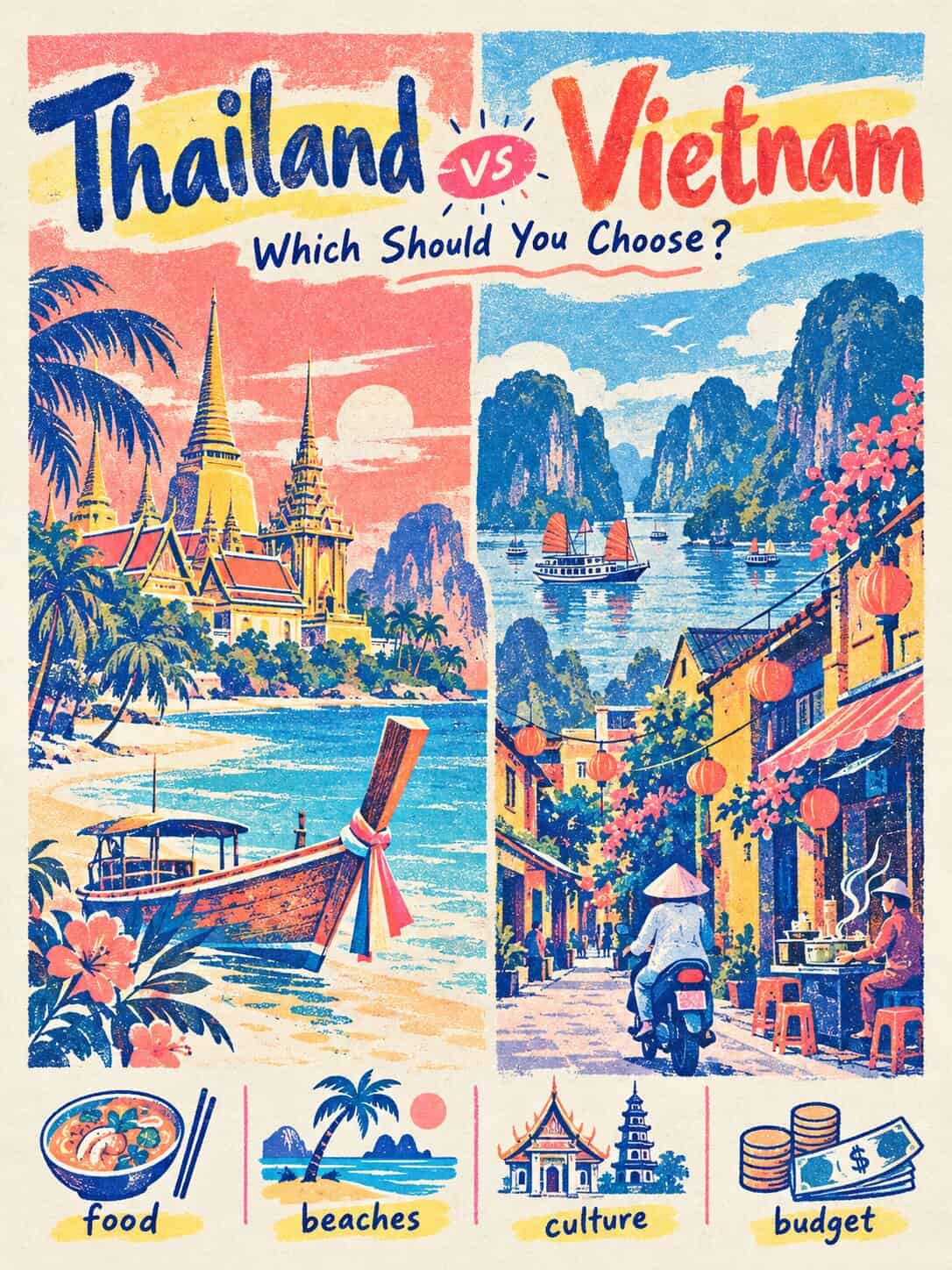
Vietnam vs Thailand: which is better for your trip? Choose Thailand if you want classic tropical islands, easy logistics and a gentle first visit to Southeast Asia. Choose Vietnam if you want lower costs, a long north-to-south route with dramatic scenery, and lighter, herb-forward food. Thailand vs Vietnam travel is one of the most common questions travelers ask, and the two are not interchangeable. Is Thailand cheaper than Vietnam? Is Vietnam or Thailand for a vacation the better pick, and is Thailand cheaper than Vietnam for your budget? This guide compares them on cost, visas, beaches, food, transport and timing for a Thailand vs Vietnam holiday, with a pick for each type of trip.
Vietnam vs Thailand at a Glance
| Thailand | Vietnam | |
|---|---|---|
| Overall cost | Moderately low, higher than Vietnam in most categories | Usually the cheaper of the two, especially for food, drinks and mid-range stays |
| Visa for many Western passports | A 30-day tourist visa exemption for around 60 countries and territories | An e-visa of up to 90 days for all nationalities, plus a 45-day exemption for a short list of countries |
| Best time to visit | November to February is the most reliable nationwide window | Regional: the north, the central coast and the south each have a different best season |
| Beaches | White sand, turquoise water and limestone cliffs, with mature island-hopping | Longer coastline, more coastal towns than island resorts |
| Getting around | Very beginner-friendly: metro, buses, domestic flights, ferries | More adventurous: motorbikes, sleeper trains, long buses |
| Food style | Bold, spicy, coconut-based | Fresh, light, herb-forward |
| Best first stop | Bangkok | Hanoi or Ho Chi Minh City |
Is Thailand Cheaper Than Vietnam? Costs in Vietnam vs Thailand
Is Thailand cheaper than Vietnam? Usually not: Vietnam tends to cost less for a similar standard of travel, which is why many Thailand vs Vietnam travel budgets tilt toward Vietnam, and the gap grows at the mid-range and luxury levels. Exact daily budgets move with exchange rates and season, so compare categories rather than a single number.
| Category | Cheaper in | What to expect |
|---|---|---|
| Budget rooms | Vietnam | Hostels and guesthouses cost slightly less in Vietnam, though both are cheap |
| Mid-range hotels | Vietnam | The difference is clearest at this level and in beach resorts |
| Street food and local meals | Close, slight edge to Vietnam | A bowl of noodles or a rice plate is inexpensive in both |
| Beer and drinks | Vietnam | Local beer is notably cheaper in Vietnam |
| Domestic transport | Depends on the route | Long buses and trains are cheap in Vietnam, while Thailand has more flight and ferry options |
| Luxury travel | Vietnam | High-end resorts cost less for similar quality |
For a two-week trip, Vietnam typically comes out noticeably cheaper for similar comfort, and the gap is smallest at the backpacker level. Read our two-week Thailand itinerary to see how a Thai route adds up.
Vietnam vs Thailand Visas: Rules Differ by Nationality
Entry rules depend on your passport, and they have changed recently, so check your own nationality on the official embassy or e-visa site before you book. Do not assume the same rules apply to everyone.
- Thailand: the old 60-day exemption has been replaced by a 30-day tourist exemption for around 60 countries and territories, including many in the EU, the UK, the USA, Australia, Canada and Japan. The new scheme is for tourism, not work, and some nationalities have a shorter stay or need a visa. See our Thailand visa guide for details.
- Vietnam: an e-visa valid for up to 90 days, single or multiple entry, is open to all nationalities and applied for online. The fee is paid on the official portal, so check the current amount there. A number of countries, including the UK, Germany, France, Italy, Spain, Japan and South Korea, get a 45-day visa-free stay, while some other nationalities such as the USA, Canada and Australia need the e-visa.
For a longer Southeast Asia trip, Vietnam’s e-visa gives more flexibility to stay without a border run, but only if you qualify, so check before you plan.
Vietnam vs Thailand Food: Bold and Spicy vs Fresh and Herbal
Thai food leans into big, layered flavors: the sweet-sour-spicy balance of pad Thai, the coconut-rich heat of tom yum and green curry, and the char of street-cart pad kra pao. Vietnamese food takes a lighter, herb-forward approach: pho’s clear, slow-simmered broth, banh mi’s crunch-and-pickle contrast, and fresh spring rolls built around raw herbs rather than heavy sauces. Neither is objectively better. If you gravitate toward rich curries and heat, Thailand will feel more immediately satisfying. If you prefer clean, herbal, less oily flavors, Vietnam will.
Thailand vs Vietnam Beaches: Thailand Wins for Classic Islands
This is the clearest differentiator. For Thailand vs Vietnam beaches, Thailand’s islands (Phuket, Krabi, Koh Phi Phi, Koh Tao, Koh Samui, Koh Phangan) deliver the white sand, turquoise water and limestone scenery of the tropical-island postcard, with a mature network of ferries and speedboats between them. See our Koh Phi Phi travel guide and the Thailand islands guide for how it works in practice. Vietnam’s coastline is longer but less island-focused. Da Nang and Phu Quoc are the standout beach destinations, but the feel leans toward coastal cities and fishing-village charm rather than dedicated island resorts. If beaches and islands are the priority, Thailand is the stronger pick in the Thailand vs Vietnam beaches comparison.
Vietnam vs Thailand Culture: Buddhist Temples vs War History and Colonial Towns
Thailand’s cultural identity centers on ornate Buddhist temples and royal palaces: Bangkok’s Wat Arun and Grand Palace, Chiang Mai’s old-city wats, and the ancient ruins at Ayutthaya Historical Park. Vietnam’s draws are different: war history museums in Ho Chi Minh City and the DMZ, French colonial architecture in Hanoi’s Old Quarter, and Hoi An’s lantern-lit riverside town. Both are Buddhist-majority at their core, but Vietnam’s 20th-century history adds a sobering layer that Thailand’s sites generally do not carry.
Getting Around in Vietnam vs Thailand: Thailand Is Easier to Navigate
Thailand’s tourist infrastructure is beginner-friendly: Bangkok’s BTS and MRT, a dense domestic flight network, and well-worn overland routes between beach towns make independent travel low-stress even on a first trip. Vietnam demands a bit more adventurousness. Motorbikes are the default way to get around many towns, and long-distance travel often means an overnight sleeper train or bus rather than a quick regional flight. Neither is difficult, but Thailand has the gentler learning curve for a Thailand vs Vietnam travel plan.
Best Time to Visit: Vietnam vs Thailand by Season
Thailand’s dry season, November to February, is the most reliable window nationwide, though February to April can bring smoky haze from agricultural burning in the north, especially around Chiang Mai. Our best time to visit Thailand guide covers the regions. Vietnam’s weather is regional and has no single nationwide season: the north is best from March to April and from September to November, the central coast is driest from March to May, and the south is most stable from December to February, with a rainy, typhoon-prone stretch from June to September. If one trip touches both countries, November to March is the overlap that works for most of Thailand and for southern and central Vietnam.
Which Should You Choose? Vietnam or Thailand for a Vacation
If you are deciding Vietnam or Thailand for a vacation (or Thailand or Vietnam for a first trip), match the country to the kind of trip:
- First visit to Southeast Asia: Thailand, for easier logistics. Start with our first-time Thailand guide.
- Beaches and islands: Thailand, with Krabi, Phuket or the Gulf islands as the base.
- Winter escape from November to March: Thailand’s south and Vietnam’s south and central coast are both good, with Thailand more reliable for sea conditions.
- Two-week trip on a budget: Vietnam, for a Hanoi to Ho Chi Minh City route with Hoi An in between, or a combined trip with a short flight between Bangkok and Hanoi or Ho Chi Minh City.
Plenty of travelers do both: direct flights between Bangkok and Hanoi or Ho Chi Minh City take under two hours, so a combined itinerary is practical for a Thailand vs Vietnam holiday. If you can only pick one Thailand vs Vietnam holiday, use the guide above to match the country to your style.
Frequently Asked Questions
Is Thailand or Vietnam cheaper to visit?
Vietnam is usually cheaper across rooms, food, drinks and activities, though the gap narrows at the backpacker level.
Do I need a visa for Thailand or Vietnam?
It depends on your nationality. Thailand offers a 30-day tourist exemption to around 60 countries and territories. Vietnam offers an e-visa of up to 90 days to all nationalities and a 45-day exemption to a short list of countries. Check the official sites for your passport.
Which has better beaches, Thailand or Vietnam?
Thailand. Its islands offer the classic white-sand, turquoise-water experience with mature ferry links, while Vietnam leans more toward coastal cities.
Is Thailand or Vietnam better for a first trip to Southeast Asia?
Thailand is the easier first trip because of simpler logistics and a dense tourist infrastructure.
Can I visit both Thailand and Vietnam on one trip?
Yes. Direct flights between Bangkok and Hanoi or Ho Chi Minh City take under two hours, so a two- to three-week combined route is common.
When is the best time to visit Thailand and Vietnam together?
November to March works for most of Thailand and for southern and central Vietnam.